The Dead Sea’s Global Significance
The Dead Sea, positioned between Israel and Jordan, is part of the Great Rift Valley system and is the lowest point on Earth. As well as being an area of outstanding beauty and environmental significance, the saline dense Dead Sea is a major source of life sustaining minerals.
- ICL Dead Sea is a global supplier of essential minerals and maintains a 652 km² concession in the Dead Sea area, employing 1,500 employees and operating on a year-round basis.
- Through its mineral extraction, ICL Dead Sea obtains vital fertilizer ingredients and contributes directly to improved food security. It also provides essential minerals to industry, while embedding sustainable practices and environmental protection.
Minerals of the Dead Sea: Essential for Life and Industry
ICL Dead Sea is a major producer of essential minerals, both for domestic use and for global export. The high quality of the Dead Sea reserves means that some potash is produced as a pure, natural product with no additives.
- 2024 production highlights:
- 3,700 kt potash
- 1,764 kt compacted potash
- 190 kt bromine
- 17 kt cast magnesium
- Applications:
- Potash: fertilizers for global agriculture and food security.
- Bromine: electronics, energy storage, safety materials.
- Magnesium: health products and applications in light industry.
Extraction and Operations at Scale
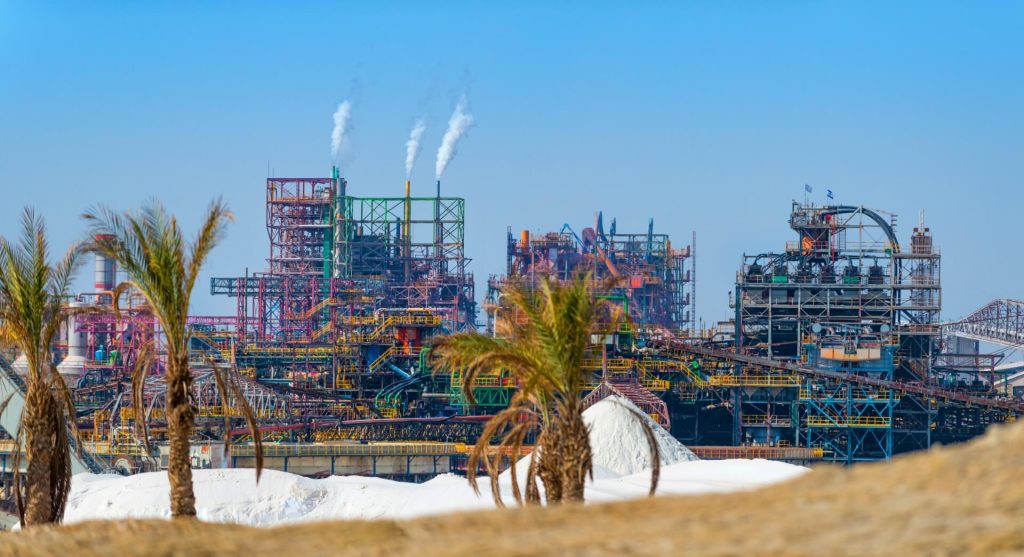
ICL Dead Sea maintains nine separate production plants that operate non-stop throughout the year. Mineral extraction and processing operations extend over a 150 km² area of the Dead Sea region’s southern basin.
- ICL Dead Sea utilizes massive evaporation ponds to harness the natural climate conditions and solar energy of the Negev Desert.
- ICL Dead Sea operations in the southern basin system support industry, communities, tourism, and the environment in a beneficial interdependent relationship.
A Sustainable Approach to Mineral Extraction
ICL Dead Sea operates in one of the world’s most unique and sensitive environments, one that is also a major tourist attraction. The company operates a comprehensive sustainability program in alignment with its core ESG strategies.
- Key focus areas for sustainability are: the implementation of circular economies, GHG reduction & energy efficiency, waste reduction & green procurement, the rehabilitation of industrial sites and the encouragement of biodiversity.
- ICL Dead Sea is embracing a cultural shift toward sustainability-driven operations and is creating a functional blueprint that other industrial companies can copy and adapt to their own operations.
Water and Resource Management
Water is a precious – and often precarious – resource in the Middle East and the Dead Sea has experienced level recession due to reduced inflows, natural evaporation, and industrial withdrawals. ICL Dead Sea is innovating to develop sustainable water management strategies.
- ICL Dead Sea’s water management in 2024:
- 470M m³ brine pumped into evaporation ponds.
- 318M m³ water returned to the northern basin.
- Net stable withdrawal: ~160M m³, consistent for decades.
- The company is also focused on maintaining southern basin water levels both for industrial requirements and to meet the demands of regional tourism.
Environmental Restoration and Stewardship
ICL Dead Sea is demonstrating a proactive commitment to environmental restoration and long-term stewardship. Through dedicated efforts to rehabilitate open areas impacted by historic mineral extraction, the company is transforming former industrial zones into thriving natural habitats.
- Its successful restoration initiatives include protecting native flora and wildlife (by reducing fencing and applying ecological remediation to key desert wetlands), restoring the Heimar Stream estuary, and creating a desert park and conservation area at Sdom Saltmarsh Lake.
- As part of its broader strategy to reduce its ecological footprint and enrich outdoor public spaces, ICL Dead Sea partners with the Tamar Regional Council, Israel’s Ministry of Environmental Protection, and the Israel Nature and Parks Authority (INPA).
Economic and Social Impact
ICL Dead Sea makes a key contribution to the economic life of the southern regions, and to the national Israeli economy. The economic activities associated with the Dead Sea plants support up to 6,200 jobs, providing prosperity and stability in desert and periphery communities.
- The southern basin ponds maintained by ICL Dead Sea add to the region’s tourist value, helping to sustain hotels and attractions.
- Protection of wetlands creates habitats for migrating birds, and local populations, protecting biodiversity and further encouraging tourism.
Looking Ahead: A Responsible Path Beyond 2030
ICL Group’s current Dead Sea concession will remain valid until March 31st, 2030. The company is engaging with the government in ongoing discussions on balancing economic and environmental priorities for the next concession period.
- The company is following various recommendations, including the Naveh Committee’s 2024 recommendation which stipulates that it continues mineral extraction while restricting negative impacts.
- ICL’s vision is to continue being a responsible steward of Dead Sea resources while supporting the national economy and implementing global sustainability goals.
An Easy to Read Summary of ICL Dead Sea and its Operations
| Category | Details |
| Location & Importance | Dead Sea (Great Rift Valley); lowest point on Earth; unique environment and mineral source. |
| Land Concession | 652 km² |
| Employees | 1,500 full-time workers |
| Global Role | Supplies essential minerals for fertilizers, tech, health, and food security. |
| 2024 Production Output | – 3,700 kt potash – 1,764 kt compacted potash – 190 kt bromine – 17 kt magnesium |
| Mineral Applications | – Potash: Global agriculture – Bromine: Electronics, safety, batteries – Magnesium: Health, lightweight industry |
| Operational Scope | 9 production plants operating year-round; 150 km² operational area in southern basin |
| Resource Strategy | Uses solar evaporation ponds; aligns with desert climate; supports regional tourism & industry |
| Sustainability Focus Areas | – Circular economy – GHG reduction – Site rehabilitation – Biodiversity – Green procurement |
| Water Management (2024) | – 470M m³ brine pumped – 318M m³ water returned to northern basin – Net stable withdrawal: 160M m³ |
| Environmental Restoration | Projects include Heimar Stream estuary, Sdom Saltmarsh Lake park, desert wetland restoration |
| Partners in Restoration | Tamar Regional Council, Israel Nature and Parks Authority (INPA), Ministry of Environment |
| Economic Contribution | Supports 6,200 jobs in southern Israel; boosts local tourism through basin aesthetics |
| Future Outlook (Post-2030) | Engaged with Israeli government on sustainable continuation after 2030 concession ends |
| Regulatory Influence | Following Naveh Committee (2024) recommendation: continued mining with stricter environmental oversight |
| Vision Beyond 2030 | Maintain role as mineral supplier + desert ecosystem steward, integrating national + ESG priorities |
Conclusion: Minerals that Sustain Life
ICL Dead Sea demonstrates that large-scale mineral production and environmental responsibility can advance together. By integrating circular economy principles, efficient water management, and proactive site rehabilitation, the company has established a measurable framework for sustainable industrial performance in one of the world’s most sensitive environments.
As ICL prepares for the next concession period beyond 2030, its focus remains clear,to secure a reliable supply of critical minerals while upholding the highest environmental and operational standards.
This approach directly supports the UN Sustainable Development Goals, particularly SDG 12 (Responsible Consumption and Production) and SDG 15 (Life on Land), by promoting resource efficiency, ecosystem restoration, and long-term stewardship.
The Dead Sea operations stand as a practical model of how disciplined ESG management, transparent data, and continuous innovation can deliver both economic value and environmental protection, proving that sustainable industry is not a vision, but a viable path forward.